

Table of Contents
- Understanding Spinal Decompression vs Physical Therapy
- How Spinal Decompression Works
- Benefits of Spinal Decompression Therapy
- Physical Therapy for Herniated Discs and Core Strength
- How Long Does Spinal Decompression Take
- Combining Both Approaches for Better Outcomes
- Choosing the Right Treatment for Your Condition
- Frequently Asked Questions
Last Updated: September 28, 2026
Understanding Spinal Decompression vs Physical Therapy
When chronic back or neck pain disrupts your daily life, two treatment approaches often emerge as viable options: [spinal decompression](/non-surgical-spinal-decompression/) and physical therapy. Each addresses pain differently, and understanding how they work helps you make an informed decision about your care.
Spinal decompression uses mechanical traction to reduce pressure on compressed nerves and damaged discs. Physical therapy, by contrast, focuses on strengthening muscles, improving mobility, and teaching your body to move better. The choice between spinal decompression vs physical therapy isn’t always straightforward, and for many patients, the answer isn’t choosing one over the other.
At Dr. Gil Center for Back, Neck, and Chronic Pain Relief, we’ve worked with hundreds of patients facing this exact decision. Some need immediate relief from nerve pain. Others require long-term stability to prevent recurrence. Many benefit most from combining both approaches strategically.
This guide breaks down how each treatment works, what results you can realistically expect, and how to determine which path, or combination, makes sense for your specific condition.
How Spinal Decompression Works
Spinal decompression is a non-surgical technique that uses controlled mechanical traction to gently separate vertebrae and reduce the pressure inside spinal discs. The goal is straightforward: take pressure off compressed nerves so pain signals diminish and healing can begin.
The process works by creating negative pressure inside the disc space. When vertebrae are pulled apart slightly, bulging or herniated disc material can move back toward its original position. This reduces nerve compression and inflammation. Treatment sessions typically last 30 minutes, during which you lie on a specialized traction device while it applies a precise pulling force to your spine.
The mechanics matter because precision matters. A generic traction device won’t produce the same results as one calibrated to your specific spinal segments and disc condition. This is why diagnosis before treatment is essential, your provider needs imaging to confirm which discs are problematic and at what level.
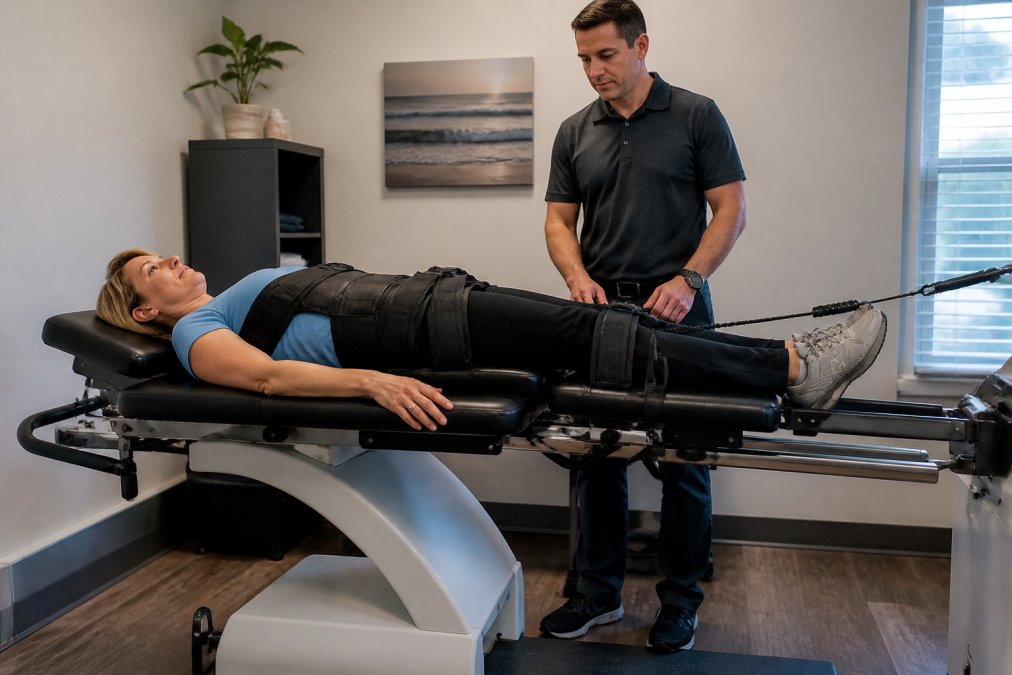
Results vary depending on your condition’s severity and duration. Some patients report relief within the first few sessions. Others need 2-3 weeks of consistent treatment before improvement becomes noticeable. The key is consistency, sporadic treatment rarely produces lasting results.
Benefits of Spinal Decompression Therapy
The primary benefit of spinal decompression is rapid pain reduction, particularly for nerve-related pain. If you’re experiencing radiating pain down your leg (sciatica) or arm pain from a cervical disc issue, decompression addresses the mechanical cause directly.
Beyond pain relief, spinal decompression therapy offers several advantages:
- Targeted treatment, It addresses the specific disc causing your pain rather than treating your entire spine
- Non-invasive approach, No surgery, no injections, no medications required
- Faster symptom relief, Many patients feel improvement within days or weeks rather than months
- Reduced inflammation, By relieving pressure, the technique reduces inflammatory responses around the nerve
- Potential disc healing, The negative pressure environment may support the disc’s natural repair mechanisms
The benefits of spinal decompression therapy become most apparent when your pain stems from a diagnosed disc herniation, bulge, or stenosis. If your MRI shows a specific mechanical problem pressing on a nerve, decompression has a clear target.
However, decompression alone doesn’t address the underlying weakness or instability that often contributed to the disc problem in the first place. This is where the limitations emerge, and where physical therapy becomes essential.
Physical Therapy for Herniated Discs and Core Strength
Physical therapy takes a different approach. Rather than reducing pressure mechanically, it rebuilds your body’s ability to support your spine properly. A physical therapist designs exercises that strengthen your core, improve your posture, and teach movement patterns that protect your discs.
Physical therapy for herniated discs focuses on several key areas:
- Core stabilization, Exercises that activate deep abdominal and back muscles that support your spine
- Flexibility and mobility, Stretching and movement work to reduce stiffness and improve range of motion
- Postural retraining, Learning how to sit, stand, and move in ways that reduce disc stress
- Functional movement, Practicing everyday activities (lifting, bending, reaching) with proper mechanics
- Pain management, Techniques like manual therapy and soft tissue work to reduce muscle tension
The strength you build through physical therapy creates a protective environment for your spine. Strong core muscles act like a built-in brace, reducing the load on your discs and preventing future injury. This is why physical therapy is essential for long-term prevention.
The challenge with physical therapy alone is timing. If you’re in acute pain from a compressed nerve, the inflammation and pain signals may prevent you from engaging effectively in strengthening exercises. Your body’s protective response, muscle guarding and reduced movement, interferes with the very exercises you need to do.
How Long Does Spinal Decompression Take
The timeline for spinal decompression depends on your condition’s severity and how your body responds. Most treatment programs run 4-6 weeks, with sessions occurring 3-4 times per week.
How long does spinal decompression take to show results? Many patients notice improvement within the first 1-2 weeks. Others require the full 4-6 weeks before significant relief emerges. A few need extended treatment beyond this initial phase.
The duration also depends on your specific diagnosis:
- Mild disc bulges, Often respond within 2-3 weeks
- Moderate herniations, Typically require 4-6 weeks of consistent treatment
- Severe stenosis or chronic cases, May need 8-12 weeks or longer
One critical factor: consistency matters more than duration. Sporadic treatment produces weaker results than regular sessions. Missing appointments extends your overall timeline.
After completing the initial decompression phase, many patients transition to physical therapy to maintain gains and build lasting stability. This combination approach often produces the most durable results.
Combining Both Approaches for Better Outcomes
Here’s where the real power emerges: using spinal decompression and physical therapy together, in a coordinated sequence.
The optimal strategy typically follows this pattern: begin with spinal decompression to reduce acute nerve compression and inflammation, then transition to physical therapy as pain improves. This sequencing allows you to benefit from decompression’s rapid pain relief while building the strength needed to prevent recurrence.
Why this combination works:
| Element | Decompression | Physical Therapy | Combined Benefit |
|---|---|---|---|
| Acute pain relief | Immediate (days-weeks) | Gradual (weeks-months) | Fast relief + lasting stability |
| Addresses root cause | Mechanical pressure only | Weakness and instability | Complete problem-solving |
| Prevents recurrence | Limited without follow-up | Excellent long-term protection | Sustained recovery |
| Time commitment | 4-6 weeks intensive | 8-12 weeks ongoing | Shorter total treatment path |
| Long-term results | Often temporary alone | Durable and progressive | Most durable outcomes |
Research from the National Center for Biotechnology Information shows that combined mechanical decompression and active rehabilitation produces better outcomes than either approach alone. The mechanical relief allows your body to participate more fully in strengthening work, while the strengthening prevents the problem from recurring.
At Dr. Gil Center for Back, Neck, and Chronic Pain Relief, we’ve integrated spinal decompression with advanced therapies like Class IV laser therapy and therapeutic ultrasound, combined with targeted physical rehabilitation. This multi-modal approach addresses pain from multiple angles simultaneously.
Choosing the Right Treatment for Your Condition
Your choice between spinal decompression and physical therapy depends on several factors specific to your situation.
Choose spinal decompression if:
- You have imaging (MRI) confirming a specific disc herniation, bulge, or stenosis
- Your pain is acute and severe, limiting your ability to function or exercise
- You have nerve-related symptoms (radiating pain, numbness, tingling)
- You’ve tried conservative care without sufficient relief
- You want to avoid surgery and need faster symptom relief
Choose physical therapy if:
- Your pain is primarily muscular or postural in nature
- You have chronic pain without acute nerve compression
- You’re recovering from an injury and need to rebuild strength
- You want to prevent future episodes through strengthening
- You’re able to exercise despite your pain level
Choose combined treatment if:
- You have both a mechanical disc problem and underlying weakness
- Your pain is severe enough to prevent you from exercising effectively
- You want the fastest path to both relief and lasting stability
- You’re seeking comprehensive care that addresses multiple factors
The reality is that most patients with chronic back or neck pain benefit from combination treatment. Your acute pain needs mechanical relief. Your long-term health needs muscular support and movement retraining.
One practical consideration: insurance coverage varies significantly. Some plans cover both modalities readily. Others require prior authorization or limit the number of sessions. Discussing coverage options with your provider helps you make a realistic plan.
Another factor is your personal timeline. If you need rapid relief to return to work or activities, decompression offers faster results.
Frequently Asked Questions
What is the difference between spinal decompression and physical therapy?
Spinal decompression uses mechanical traction to reduce pressure on spinal discs and nerves, providing targeted relief for disc-related pain. Physical therapy focuses on strengthening core muscles, improving flexibility, and correcting movement patterns to prevent future injury. Decompression addresses immediate nerve compression, while physical therapy builds long-term stability and function. Both treat chronic back pain but through different mechanisms.
Can spinal decompression be used alongside physical therapy?
Yes, combining spinal decompression with physical therapy often produces better results than either treatment alone. Decompression reduces pain and pressure on nerves, while physical therapy strengthens muscles to support the spine. This integrated approach addresses both immediate symptoms and underlying weakness. Many patients benefit from starting with decompression for pain relief, then transitioning to physical therapy for long-term stability and prevention of recurrence.
How long does spinal decompression take to show results?
Most patients begin noticing pain relief within the first few weeks of spinal decompression treatment. However, the full course typically spans several weeks to months, depending on the severity of your condition and your body’s response. Consistency matters, completing the recommended number of sessions increases the likelihood of sustained improvement. Your treatment plan will be personalized based on your specific diagnosis and how your body responds to therapy.
Is spinal decompression covered by insurance?
Insurance coverage for spinal decompression varies by plan and diagnosis. Some insurers cover it when deemed medically necessary for conditions like herniated discs or spinal stenosis, while others may not. Coverage depends on your specific policy, the condition being treated, and whether conservative treatments have been tried first. Contact your insurance provider or speak with your healthcare provider’s office to verify coverage for your situation.


