

Table of Contents
- What Is Spinal Decompression Therapy?
- Conditions Treated by Spinal Decompression
- How Spinal Decompression Works
- Non-Surgical Alternatives for Chronic Back Pain
- What to Expect During Spinal Decompression
- Is Spinal Decompression Right for You?
- Recovery and Post-Treatment Care
- Frequently Asked Questions
Last Updated: September 25, 2026
What Is Spinal Decompression Therapy?
Spinal decompression therapy is a non-surgical treatment that uses mechanical traction to relieve pressure on spinal nerves and discs. The therapy works by gently stretching the spine, creating negative pressure within the intervertebral discs. This negative pressure can help retract bulging or herniated disc material back into place, reducing nerve compression and the pain that results from it. (Source: National Institute of Neurological Disorders and Stroke (NINDS) on sciatica)
The treatment is performed on a specialized table that uses precise, controlled movements to decompress specific vertebral segments. Unlike general spinal traction, decompression therapy targets problem areas with computer-guided accuracy.
The therapy is outpatient-based, and sessions occur over several weeks. The goal is addressing the underlying mechanical problem so you can maintain recovery through proper posture and lifestyle changes.
Conditions Treated by Spinal Decompression
Spinal decompression therapy addresses herniated discs (where disc material protrudes and compresses nerves) and bulging discs (where the outer layer weakens but doesn’t rupture), as the negative pressure helps reposition the disc.
Sciatica (sharp pain radiating down the leg from sciatic nerve compression), degenerative disc disease, and radiculopathy (nerve pain from nerve root compression) often improve with decompression therapy combined with rehabilitation.
Spinal stenosis, facet joint syndrome, and chronic neck pain may benefit from decompression therapy when surgery isn’t yet necessary.
How Spinal Decompression Works
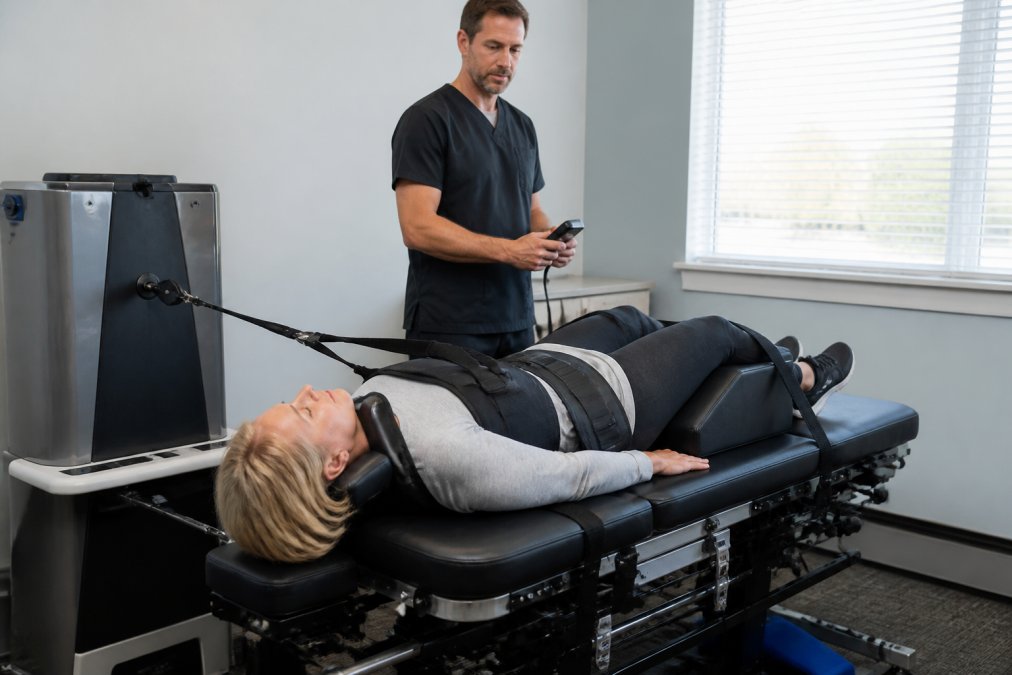
The mechanism behind spinal decompression therapy involves creating a controlled stretch of the spine using a motorized table. When you lie on the decompression table, harnesses secure your pelvis and torso. The table then applies a precise pulling force that gradually increases, creating tension along the spine. This controlled traction generates negative pressure, also called distraction, within the intervertebral discs.
This negative pressure pulls disc material back toward the center, drawing herniated material back inside the disc wall and relieving outward pressure on bulging discs. The negative pressure also increases blood flow to the disc, promoting nutrient delivery and healing.
The table uses cycles of tension and relaxation, preventing the body’s protective muscle guarding response. The computer-guided system targets specific vertebral segments with precision that manual traction cannot achieve.
Sessions typically last 20 to 30 minutes, with the actual decompression phase lasting 15 to 20 minutes. Over multiple sessions, the cumulative effect allows discs to heal and nerve impingement to decrease.
Non-Surgical Alternatives for Chronic Back Pain
Understanding how different non-surgical treatments work helps clarify which approach addresses your specific problem.
Decompression Therapy vs. Spinal Traction
Traditional traction applies continuous pulling to stretch the spine and reduce muscle tension, but doesn’t create the sustained negative pressure inside discs that spinal decompression therapy does. Decompression uses computer-guided cycles of tension and release to retract disc material back toward the disc center, whereas traction primarily stretches surrounding tissues. For patients with documented herniated or bulging discs causing nerve compression, decompression offers a more targeted approach.
Physical Therapy and Chiropractic Care
Physical therapy improves mobility and strength but doesn’t create mechanical decompression of compressed discs. Chiropractic adjustments improve alignment but don’t generate the negative pressure needed to decompress a bulging or herniated disc. Many patients benefit most from combining decompression therapy with physical therapy: decompression addresses the mechanical disc problem, while physical therapy prevents the movement patterns and muscle imbalances that caused it.
Anti-Inflammatory Medications and Injections
Anti-inflammatory medications and epidural steroid injections manage pain but don’t address the underlying mechanical problem. Their effects are temporary; once medication wears off, symptoms often return if the disc hasn’t been decompressed. Decompression therapy requires multiple sessions over weeks but aims for lasting mechanical change rather than temporary symptom suppression.
Surgical Intervention
Surgery removes disc material or bone to relieve nerve compression but is irreversible and carries surgical risks. Decompression therapy offers a non-invasive alternative to explore before surgery becomes necessary, and attempting it first preserves your options.
The Integration Advantage
Combining decompression therapy with physical therapy exercises, ergonomic modifications, and activity adjustments addresses multiple aspects of the problem simultaneously. Patients who commit to post-treatment lifestyle changes tend to sustain improvement, whereas those who return to previous habits often see symptoms recur.
What to Expect During Spinal Decompression
Your first appointment includes a consultation where we assess your medical history, imaging results, and current symptoms. We’ll discuss what brought you in, whether it’s herniated discs, sciatica, or chronic neck pain, and explain how decompression therapy addresses your specific condition. This conversation helps us determine whether you’re a candidate and what outcomes are realistic for your situation. Integrating these clinical sessions with various natural pain treatments can often provide a more comprehensive approach to managing long-term discomfort and supporting the body’s healing process.
(Source: [National Institute of Arthritis and Musculoskeletal and Skin Diseases (NIAMS) on back pain](https://www.niams.nih.gov/health-topics/back-pain))
When treatment begins, you’ll lie on the specialized decompression table, fully clothed. Harnesses secure your pelvis and upper body comfortably but firmly. The table is adjusted to target the affected area, your lumbar spine if you have lower back pain, or your cervical spine for neck issues. The practitioner starts the session, and the table begins its cycle of gentle pulling and releasing.
You’ll feel a controlled stretch, but it shouldn’t be painful. Many patients describe it as a relieving sensation, similar to the stretch you feel when you lean back in a chair. The table operates quietly, and you remain conscious throughout. Some patients relax so completely they fall asleep during sessions. Each session lasts 20 to 30 minutes total, though the actual decompression phase is typically 15 to 20 minutes.
How Long Does a Spinal Decompression Session Take?
A typical spinal decompression session takes 20 to 30 minutes from start to finish. The actual decompression phase, when the table is actively creating negative pressure, usually lasts 15 to 20 minutes. The remaining time includes positioning you on the table, monitoring your comfort, and gradually bringing you back to neutral before you get up.
The full treatment course typically involves multiple sessions over several weeks. Most patients attend sessions 2 to 5 times per week initially, then taper frequency as symptoms improve.
Is Spinal Decompression Right for You?
Spinal decompression therapy works best for patients with documented disc problems, herniated discs, bulging discs, or degenerative disc disease, that are causing nerve compression symptoms. If your pain is accompanied by numbness, tingling, or radiating sensations down your leg or arm, imaging confirmation is important. An MRI or CT scan should show that a disc problem is actually causing your symptoms, not another condition like arthritis alone or muscle strain.
Ideal Candidates
Patients most likely to benefit from decompression therapy have:
- Confirmed disc pathology on imaging. MRI or CT findings showing herniation, bulging, or degeneration that correlates with your symptoms.
- Nerve compression symptoms. Radiating pain, numbness, or tingling in the distribution of a specific nerve root (sciatica, cervical radiculopathy, etc.).
- Failed conservative care. You’ve tried physical therapy, anti-inflammatory medications, or other non-invasive treatments without lasting relief.
- No surgical hardware or fusion. Your spine hasn’t been surgically altered in a way that would make decompression unsafe.
- Realistic expectations. You understand that decompression addresses mechanical problems but requires commitment to post-treatment exercise and lifestyle changes to maintain results.
- Adequate healing time. You’re willing to commit to a treatment course over several weeks rather than expecting immediate relief.
Contraindications: When Decompression Is Not Appropriate
Certain conditions make spinal decompression therapy unsuitable or unsafe:
- Severe osteoporosis. Weakened bone density increases fracture risk during the pulling force of decompression. Bone density screening (DEXA scan) may be needed if you have risk factors.
- Spinal fusion hardware or implants. Metal rods, screws, or fusion cages can shift or be damaged by decompression forces. Your surgeon’s clearance is necessary.
- Active spinal infection. Osteomyelitis or discitis (bone or disc infection) can be worsened by mechanical manipulation. The infection must be treated first.
- Cauda equina syndrome. This rare but serious condition involving compression of multiple nerve roots in the lower spine requires emergency surgical decompression, not mechanical therapy.
- Pregnancy. The abdominal harness and spinal forces are not safe during pregnancy.
- Recent spinal surgery. Most surgeons recommend waiting 6 to 12 weeks after surgery before beginning decompression therapy, allowing surgical sites to heal. Your surgeon’s clearance is essential.
- Severe spinal instability. If your spine has excessive movement or ligament damage causing instability, decompression can worsen the problem. Stability must be confirmed before treatment.
- Malignancy involving the spine. Cancer in the spine or spinal cord requires oncologic treatment, not mechanical decompression.
- Severe cardiovascular disease. The physical stress of decompression may not be appropriate for patients with unstable heart conditions. Medical clearance is necessary.
- Uncontrolled high blood pressure. Decompression can temporarily elevate blood pressure; control is important before starting.
Age and Other Factors
The Evaluation Process
Recovery and Post-Treatment Care
Recovery from spinal decompression therapy is straightforward because it’s a non-invasive outpatient procedure. You can return to normal daily activities immediately after each session. Most patients experience no downtime or restrictions. However, the quality of your recovery depends heavily on what you do between sessions and after treatment ends.
Frequently Asked Questions
How does spinal decompression therapy work for chronic back pain?
Spinal decompression therapy uses controlled traction to create negative pressure within the spine. This reduces pressure on nerves and discs, allowing herniated or bulging discs to retract. The process promotes healing by improving blood flow and nutrient delivery to damaged spinal segments. Over time, this can relieve chronic back pain without surgical intervention.
What conditions are commonly treated with spinal decompression?
Spinal decompression addresses herniated discs, bulging discs, sciatica, radiculopathy, degenerative disc disease, spinal stenosis, and facet joint syndrome. It works for both cervical spine (neck) and lumbar spine (lower back) conditions. The therapy is effective for patients experiencing nerve impingement and chronic pain from these conditions who have not found relief through other conservative treatments.
How long does a spinal decompression session take?
A typical spinal decompression session lasts 20 to 30 minutes. Your actual treatment time depends on your specific condition and the therapeutic protocol recommended for your case. Sessions are usually scheduled as an outpatient procedure, allowing you to return to daily activities. Your treatment plan will outline the recommended frequency and duration based on your individual needs.
Is spinal decompression therapy covered by insurance?
Insurance coverage for spinal decompression varies by plan and provider. Some insurance companies cover it as a non-surgical alternative when conservative treatments have been exhausted, while others may classify it differently. Contact your insurance provider directly to verify your coverage. A qualified healthcare provider can also help you understand your options and discuss financing if needed.


