

Table of Contents
- What a Herniated Disc Is and Why Most Cases Heal Without Surgery
- Non-Surgical Treatment for Herniated Discs: Your Core Options
- How to Relieve Sciatica Pain at Home
- Spinal Decompression Therapy Benefits for Disc Injuries
- Chiropractic Care for Herniated Discs: What to Expect
- The Mental Side of Chronic Pain and Why It Matters
- Ergonomics at Home and Work: Protecting Your Spine Daily
- Costs, Insurance, and Long-Term Outcomes: Non-Surgical vs. Surgical
- Frequently Asked Questions
Last Updated: September 12, 2026
What a Herniated Disc Is and Why Most Cases Heal Without Surgery
A herniated disc is a condition in which the soft, gel-like center of a spinal disc pushes through a tear in its tougher outer ring, potentially pressing on nearby nerve roots and causing pain, numbness, or weakness. The good news: the vast majority of people improve with time and conservative care.
At Dr. Gil Center for Back, Neck, and Chronic Pain Relief, we’ve spent over 28 years helping patients across Middle Tennessee recover from lumbar disc herniation and the radiating leg pain it causes. The clinical picture is encouraging. According to clinical guidance from the American Academy of Orthopaedic Surgeons, most herniated discs respond to non-surgical treatment within a few weeks to a few months.
Why? Discs have a limited but real capacity to heal. Inflammation around the nerve root subsides, and the protruding material can shrink or reabsorb over time. That means the first line of care is almost always conservative management, not the operating room.
Below, we break down every major non-surgical treatment for herniated discs, from medication and physical therapy to spinal decompression and ergonomic changes you can make today.
Non-Surgical Treatment for Herniated Discs: Your Core Options
Non-surgical treatment for herniated discs typically combines several approaches rather than relying on one. A common framework includes medication, therapeutic exercise, and targeted procedures, adjusted to your symptoms and stage of recovery.
Most patients start with the least invasive options and add layers only if needed. Here’s how the main categories compare:
| Approach | What It Does | Typical Role |
|---|---|---|
| Medications | Reduce pain and inflammation | Early symptom relief |
| Physical therapy | Strengthens supporting muscles | Core recovery tool |
| Epidural injections | Calm nerve-root inflammation | For persistent radiculopathy |
| Spinal traction | Creates space for the disc | Adjunct for nerve compression |
| Chiropractic care | Restores spinal mobility | Complements other care |
Medications and Pain Management
Over-the-counter non-steroidal anti-inflammatory drugs are often the first step for inflammation reduction. For sharper pain, a clinician may prescribe stronger options or muscle relaxants to ease spasm.
These medications manage symptoms; they don’t repair the disc. That’s why they work best alongside active treatment.
Physical therapy and Therapeutic Exercise
Physical therapy is the backbone of most conservative treatment plans. A therapist guides you through therapeutic exercise that strengthens the muscles supporting your spine, improves flexibility, and reduces strain on the injured disc.
A common mistake is resting too long. Prolonged bed rest weakens supporting muscles and can slow recovery. Gentle, guided movement almost always beats total inactivity.
Epidural Steroid Injections and Spinal Traction
When nerve irritation persists, an epidural steroid injection delivers anti-inflammatory medication directly near the affected nerve root. It can quiet radiculopathy enough for physical therapy to progress.
Spinal traction gently stretches the spine to reduce pressure on the disc. It’s often paired with other therapies rather than used alone.
How to Relieve Sciatica Pain at Home
Home care for sciatica is not about finding one magic stretch. It is about reducing nerve irritation long enough for the underlying disc to calm down. That means understanding why each habit helps, not just copying a list.
Why Position Matters More Than You Think
A herniated disc in the lower back presses on a nerve root that travels down the leg. Certain positions increase that pressure; others relieve it. The goal at home is to spend more of your day in the relieving positions.
- Lying on your back with a pillow under your knees flattens the lumbar curve slightly and reduces load on the disc. This is the single most reliable position for most people during an acute flare.
- Lying on your side with a pillow between your knees keeps the hips and pelvis aligned and prevents the top leg from dragging the spine into rotation.
- Avoid lying flat on your stomach. It arches the lower back and typically worsens nerve compression.
Heat, Cold, and What Each Actually Does
Cold and heat are not interchangeable, they do different jobs.
- Cold (first 48 to 72 hours of a flare): Narrows blood vessels, reduces swelling and inflammation around the irritated nerve root (medlineplus.gov). Use a cold pack wrapped in a thin cloth for 15 to 20 minutes at a time.
- Heat (after the acute phase): Relaxes muscle spasm and increases blood flow to tight supporting muscles. Moist heat for 15 to 20 minutes is usually better tolerated than dry heat.
Alternating the two is common, but pick based on your dominant symptom: sharp, inflamed pain responds better to cold; deep, achy muscle tightness responds better to heat.
Movement: The Counterintuitive Part
Prolonged bed rest is one of the most common self-inflicted setbacks. Beyond a day or two, it weakens the muscles that support the spine and slows recovery (peer-reviewed research).
- Walk short, frequent distances rather than one long walk. Five to ten minutes at a time, several times a day, keeps the spine moving without overloading it.
- Avoid prolonged sitting. Sitting increases intradiscal pressure more than standing or walking. If you must sit, get up every 20 to 30 minutes.
- Skip the stretches that reproduce leg pain. A gentle stretch that produces a mild, centralizing sensation is fine. A stretch that shoots pain down the leg is a signal to stop.
Positions and Habits to Avoid During a Flare
- Heavy lifting, especially with a bent-and-twisted spine
- Prolonged bending forward (loading the dishwasher, gardening, folding laundry on the floor)
- Sleeping on a soft mattress that lets the lower back sag
- High-impact activity like running or jumping
When Home Care Is Not Enough
Home care manages symptoms. It does not replace a diagnosis. If pain is worsening week over week, if you notice new weakness in the leg or foot, or if numbness is spreading, that is a signal to seek care rather than push through.
Keep a simple two-line daily log: what you did and how your leg felt that evening. Patterns emerge fast, often within a week, and that log becomes genuinely useful information for your provider when you do seek care.
Spinal Decompression Therapy Benefits for Disc Injuries
Spinal decompression therapy benefits disc injuries by gently stretching the spine to create negative pressure, which can draw the herniated material back toward its center and improve circulation to the area.
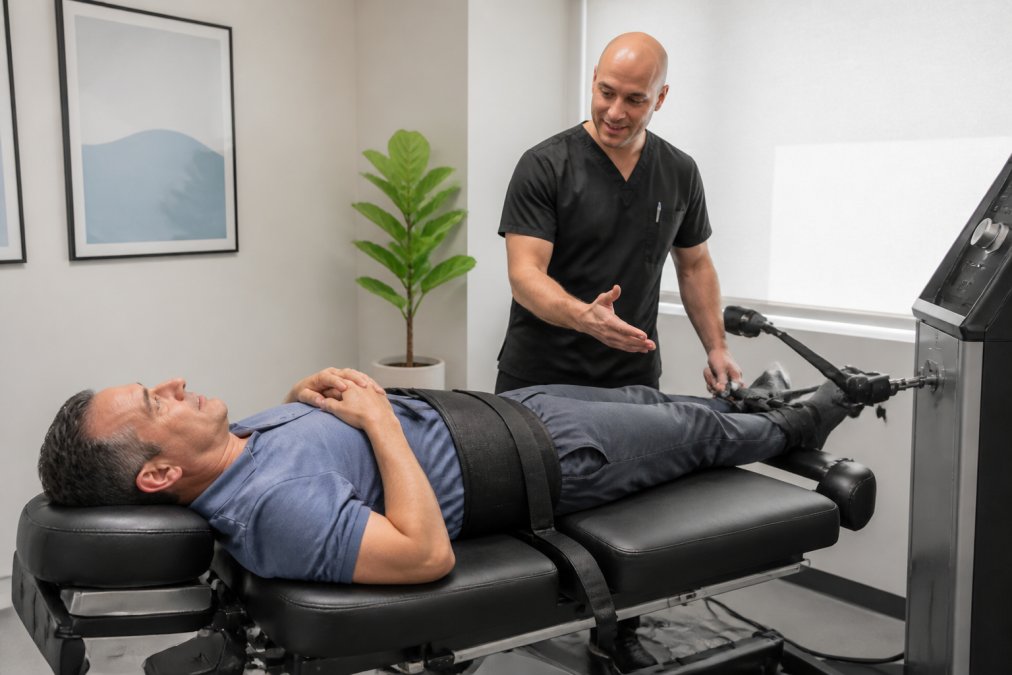
Unlike general traction, spinal decompression uses a computer-controlled table that cycles through precise forces and angles. Many patients find it comfortable, and it’s non-invasive.
Spinal decompression works best when it’s part of a broader plan, not a standalone fix. Pairing it with therapeutic exercise and posture correction tends to produce more durable results than decompression alone.
Chiropractic Care for Herniated Discs: What to Expect
Chiropractic care for herniated discs focuses on restoring spinal alignment and mobility without surgery. Expect a thorough exam, possibly including imaging studies like an MRI, before any adjustment.
Your first visit usually covers history, a physical and neurological exam, and a discussion of goals. Treatment may include spinal mobilization, gentle adjustments, and at-home guidance.
If you’re coming from another provider, expect a different pace. Good chiropractic care for a disc injury is deliberate, not aggressive. Sharp manipulation during an acute phase can aggravate symptoms.
The Mental Side of Chronic Pain and Why It Matters
Chronic pain changes how you sleep, focus, and feel. That psychological toll isn’t separate from your recovery, it’s part of it.
Many patients underrate this. Fear of movement leads to inactivity, which weakens supporting muscles and deepens the pain cycle. Addressing anxiety and stress is a genuine part of a conservative treatment plan.
A multidisciplinary approach, combining hands-on care with education and reassurance, tends to help patients stay engaged long enough to heal.
Ergonomics at Home and Work: Protecting Your Spine Daily
Ergonomics is the practice of arranging your workspace and daily habits to reduce strain on your spine. Small changes add up, especially for office workers with chronic discomfort.
Start with these adjustments:
- Set your chair so feet rest flat and knees sit near hip level
- Raise your screen to eye level to prevent forward head posture
- Support your lower back with a small cushion or lumbar roll
- Stand and stretch every 30 to 45 minutes
- Keep your phone at eye level instead of bending your neck
Posture correction during the workday protects the gains you make in treatment. Without it, daily strain can undo progress.
Costs, Insurance, and Long-Term Outcomes: Non-Surgical vs. Surgical
Most people weighing a herniated disc treatment want the same two answers: what will this cost me, and will conservative care actually hold up over time? Here’s a realistic framework.
What Non-Surgical Care Typically Costs
Non-surgical treatment is almost always less expensive than surgery, but “less expensive” covers a wide range. A few patterns most practitioners see:
- Physical therapy: Billed per visit, with a typical course running 6 to 12 visits over 6 to 8 weeks. Most commercial plans apply a copay or coinsurance per session once a deductible is met.
- Epidural steroid injections: Priced as a procedure, not a visit, and often require prior authorization. Many plans cover them when imaging and symptoms support the diagnosis.
- Chiropractic and spinal decompression: Coverage is the most variable of any category. Some plans include a fixed number of visits per year; others exclude decompression entirely as investigational.
- Medications: The cheapest line item, but ongoing NSAID use carries its own long-term risks (gastrointestinal, cardiovascular, kidney) that add hidden cost.
How Insurance Actually Handles This
Three variables decide what you pay:
- Deductible status. Until your deductible is met, you may pay the full negotiated rate for each service.
- Prior authorization. Injections, advanced imaging, and decompression frequently require pre-approval. Skipping that step is the most common cause of denied claims.
- Medical necessity documentation. Plans want to see that conservative care was tried and documented before approving escalation. A clear paper trail from your provider protects you here.
Before committing to a multi-week plan, ask your provider’s billing office for the CPT codes involved and call your insurer with those codes. That single step prevents most surprise bills.
Long-Term Outcomes: What the Comparison Actually Shows
This is where most guides go quiet, and it’s the part patients most need.
- The majority of herniated discs improve without surgery. Clinical guidance from the American Academy of Orthopaedic Surgeons and similar bodies consistently reflects that most people with lumbar disc herniation and radiculopathy improve over weeks to a few months with conservative care.
- Short-term, surgery can relieve leg pain faster. For patients with severe, persistent radiculopathy, discectomy often produces quicker leg-pain relief than continued conservative care.
- Long-term, the gap narrows considerably. A common pattern reported in the clinical literature is that by one to two years, outcomes between surgery and continued non-surgical care converge for many patients, meaning the early advantage of surgery does not always translate into a durable difference.
- Recovery downtime differs sharply. Surgery carries anesthesia risk, infection risk, and weeks of restricted activity. Conservative care carries far lower procedural risk but requires sustained participation.
The Trade-Off in Plain Terms
Choosing conservative care is not “waiting.” It is an active treatment path with its own timeline, its own costs, and its own evidence base. The honest framing is this: non-surgical care is lower risk and usually lower cost, but it demands patience and consistency. Surgery can be faster for leg pain, but it is not a guaranteed permanent fix and it carries real recovery burden.
Ask your provider two questions before deciding: (1) What is the documented plan if conservative care has not produced measurable improvement in 6 to 8 weeks? (2) What specific symptoms would move us to consider surgery? Having those answers in advance keeps the decision clinical rather than reactive.
Delaying care to “see if it goes away” is a common mistake. If you develop progressive weakness, loss of bladder or bowel control, or numbness in the saddle area, seek immediate medical attention. Those are red flags, not something to manage at home.
Frequently Asked Questions
What is the newest non-surgical treatment for herniated discs?
Spinal decompression therapy is one of the most advanced non-surgical options available. It uses a motorized table to gently stretch the spine, creating negative pressure that can help retract herniated material and allow nutrients to flow into the disc. Other newer approaches include Class IV laser therapy for inflammation reduction and MedX rehabilitation for targeted muscle strengthening. These are often combined with physical therapy and chiropractic adjustments for a multidisciplinary approach. A qualified provider can assess whether you are a candidate for these treatments.
How long does it take for a herniated disc to heal without surgery?
Many people experience meaningful symptom relief within four to six weeks of conservative management, though full recovery can take three to six months. The acute phase typically involves rest and anti-inflammatory measures, followed by a gradual return to activity with therapeutic exercise. Factors like age, overall health, the severity of nerve root compression, and how consistently you follow your recovery protocol all affect the timeline. Some patients need ongoing chiropractic care or spinal decompression to manage flare-ups.
Can chiropractic care for herniated discs really help, or is it dangerous?
When performed by a licensed chiropractor who has reviewed your imaging studies, chiropractic care can be a safe and effective part of a conservative treatment plan. Techniques like spinal mobilization and the McKenzie method are gentle and aim to reduce nerve irritation and improve posture correction. A chiropractor should avoid high-velocity adjustments if you have a neurological deficit or severe disc extrusion. Always share your MRI results and complete medical history so your provider can tailor the approach to your condition.
What can I do at home to relieve sciatica pain from a herniated disc?
For short-term relief, try alternating cold packs (first 48-72 hours) and then heat to relax surrounding muscles. Gentle stretching like knee-to-chest and sciatic nerve glides can ease tension. Avoid prolonged sitting and heavy lifting during the acute phase. Over-the-counter non-steroidal anti-inflammatory drugs may reduce inflammation, but check with your doctor first. If pain worsens or you notice weakness or numbness, stop and seek professional care. A physical therapist can design a safe home routine for your specific level of disc injury.
What are the long-term success rates of non-surgical treatment compared to surgery?
Research consistently shows that for most people with lumbar disc herniation, conservative management yields outcomes similar to surgery after one to two years, without the risks of an operation. Surgery such as discectomy may provide faster short-term relief for severe radiculopathy, but many patients still need rehabilitation afterward. A multidisciplinary approach that includes physical therapy, activity modification, and ergonomic changes addresses the root causes and reduces the chance of recurrence. Discuss your specific case with a specialist to weigh the pros and cons.
How can I set up my home office to prevent herniated disc pain from getting worse?
Position your monitor at eye level so your neck stays neutral. Use a chair with lumbar support and keep your feet flat on the floor or a footrest. Your elbows should rest at about 90 degrees when typing. Take a standing or walking break every 30 minutes to reduce disc pressure from prolonged sitting. A sit-stand desk can help you alternate positions. These ergonomic adjustments, combined with posture correction exercises, support your spine during the workday and complement your non-surgical treatment plan.
Will my back ever be the same after a herniated disc?
Many people return to their normal activities without ongoing pain, but ‘the same’ can mean different things. The disc itself may not fully regenerate, yet symptoms often resolve as inflammation subsides and surrounding muscles get stronger. Some patients remain more susceptible to flare-ups and benefit from lifelong habits like regular exercise, weight management, and proper lifting technique. A personalized recovery protocol can help you regain function and reduce the chance of future problems.
What happens if a herniated disc goes untreated?
An untreated herniated disc can lead to worsening nerve root compression, which may cause increased pain, numbness, or muscle weakness in the affected leg or arm. In rare cases, severe compression can affect bowel or bladder control, which requires immediate medical attention. Most discs do not heal on their own without some form of conservative management, and chronic pain can impact your mental health and daily life. Early intervention with a qualified provider can help prevent these complications and support your recovery.


