

Table of Contents
- What Is Laser Therapy for Joint Discomfort?
- How Laser Therapy Works for Inflammation
- Class 4 Laser Therapy for Arthritis
- Laser Therapy Recovery Time and What to Expect
- Conditions That May Benefit From Laser Therapy
- Is Laser Therapy Safe? Side Effects and Limitations
- How Laser Therapy Compares to Other Pain Treatments
- Home-Use Devices, Insurance, and Cost Considerations
- Frequently Asked Questions
Last Updated: September 16, 2026
What Is Laser Therapy for Joint Discomfort?
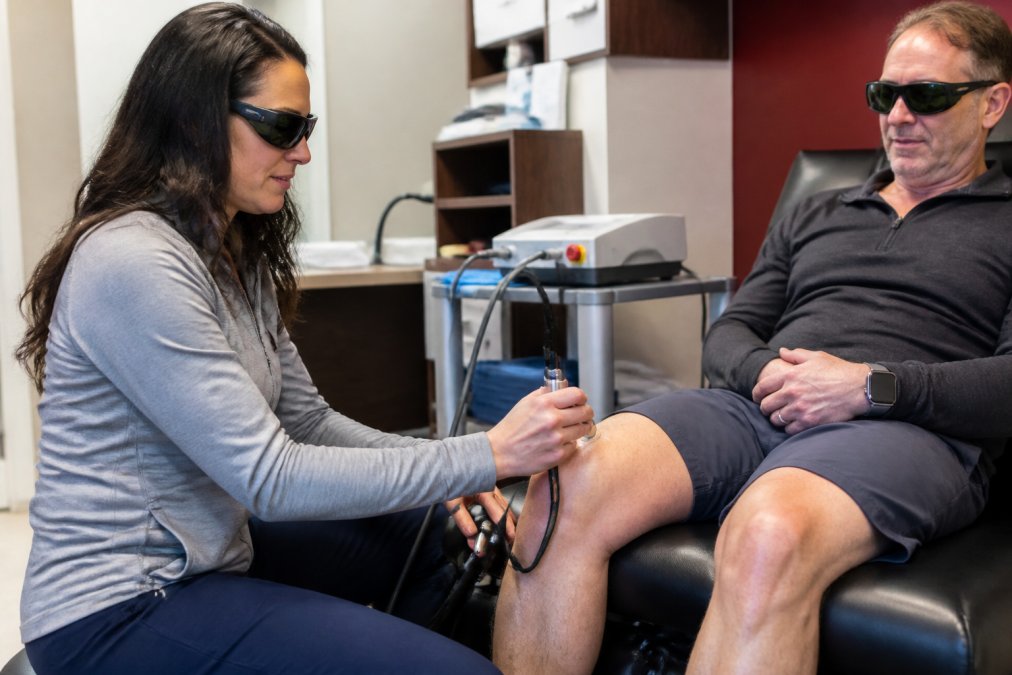
Laser therapy for joint discomfort is a non-invasive treatment that directs specific wavelengths of light energy into damaged or inflamed joint tissue to reduce pain and support healing. At Dr. Gil Center for Back, Neck, and Chronic Pain Relief, we’ve used this approach for years alongside spinal decompression and other therapies. It’s also called photobiomodulation, or PBM. (Source: National Institute on Aging’s information on arthritis)
How Light Energy Interacts With Joint Tissue
Infrared light at therapeutic wavelengths penetrates the skin and reaches tissue below the surface (Near-infrared photonic energy penetration). Once there, it’s absorbed by components within the cells, which triggers a series of responses associated with reduced inflammation and improved tissue repair. The light itself doesn’t generate heat at therapeutic doses, which is why the treatment is often described as “cold laser” therapy even when the device is more powerful.
How Laser Therapy Works for Inflammation
Laser therapy works for inflammation by influencing cellular activity in the treated area rather than masking pain at the nerve level. This is different from how a painkiller works, and it’s why results tend to build over a series of sessions rather than appearing after one visit.
Photobiomodulation and Cellular Activity
Photobiomodulation is the process by which light energy interacts with cells to influence their function. In practice, this means the light may support the body’s own healing process rather than override it. Many practitioners describe the goal as creating better conditions for recovery, not forcing a specific outcome.
Ask which class of laser the clinic uses before booking. A Class 3 device and a Class 4 device are not interchangeable, and the difference affects how deep the light reaches and how long a session takes.
Class 4 Laser Therapy for Arthritis
Class 4 laser therapy for arthritis uses higher-power devices that deliver therapeutic light deeper into joint tissue. This makes it a reasonable option for larger joints like the knee or shoulder, where lower-power devices may not reach the target area effectively.
Class 3 vs. Class 4: What the Difference Means for You
| Factor | Class 3 Laser | Class 4 Laser |
|---|---|---|
| Power level | Lower | Higher |
| Depth of penetration | Shallower | Deeper |
| Typical session length | Longer | Shorter |
| Best suited for | Smaller, superficial areas | Larger joints, deeper tissue |
| Supervision | Often used in home devices | Clinical use with trained staff |
The practical takeaway: if your discomfort is in a large joint or deep tissue, a Class 4 device is generally the more appropriate clinical choice. If it’s a small, surface-level area, a Class 3 device may be sufficient.
Laser Therapy Recovery Time and What to Expect
Laser therapy recovery time is usually minimal. Most people return to normal activity immediately after a session, and there’s no standard downtime. Some notice mild soreness in the treated area for a day or so, which typically resolves on its own.
Skipping sessions or stopping early because you feel better is one of the most common reasons results don’t hold. Improvement often continues for weeks after a course finishes, so a short-term good day isn’t a signal to stop.
Conditions That May Benefit From Laser Therapy
Laser therapy is most often used for musculoskeletal and inflammatory conditions. It’s not a universal treatment, and it works better for some issues than others.
Conditions commonly treated include:
- Osteoarthritis of the knee, hip, and hand
- Tendon-related pain such as tennis elbow
- Muscular strain and overuse syndromes
- Joint stiffness after injury or immobilization
- Chronic neck and back pain
- Soft tissue injuries from auto accidents, including whiplash
Is Laser Therapy Safe? Side Effects and Limitations
Laser therapy is generally well tolerated when performed by a trained provider using appropriate settings. Reported side effects are usually mild and short-lived. The most common ones include temporary soreness, mild redness, or a sensation of warmth in the treated area.
How Laser Therapy Compares to Other Pain Treatments
Laser therapy sits between conservative care and more invasive options. It’s less aggressive than steroid injections or surgery, and more targeted than general pain medication. But the useful comparison isn’t just about invasiveness, it’s about what each approach actually does to the joint, how long relief tends to last, and how they fit together. Integrating these light-based treatments with structured physiotherapy for pain ensures that the underlying mechanical imbalances are addressed alongside the immediate reduction of inflammation.
| Approach | How It Works | Typical Onset | Duration of Effect | Best Role |
|---|---|---|---|---|
| Laser therapy (PBM) | Light energy absorbed by cells; supports reduced inflammation and tissue repair | Builds over several sessions | Cumulative; often weeks to months after a course | Reducing inflammation, supporting repair in a broader plan |
| Physical therapy | Loads and retrains tissue; builds strength and mobility | Weeks | Durable if maintained | Rebuilding capacity and function |
| Oral NSAIDs | Blocks pain and inflammation signaling systemically | Hours | Short-term; ends when the dose stops | Temporary symptom control |
| Steroid injection | Suppresses inflammation locally | Days | Variable; often weeks to a few months | Short-term flare control |
| Hyaluronic acid injection | Supplementing joint fluid to improve lubrication | Weeks | Variable | Selected knee osteoarthritis cases |
| Surgery | Structural correction or replacement | Months | Potentially long-lasting | Structural problems that haven’t responded to conservative care |
A few practical points that the table can’t capture:
- NSAIDs and laser therapy aren’t competing. One manages symptoms in the moment; the other is used over a series of visits to support the tissue environment. Many patients use both during a flare.
- Steroid injections can reduce inflammation quickly, but they’re not designed for repeated long-term use. Repeated injections in the same joint carry cumulative risks, which is one reason providers look for non-invasive options to layer in between injections.
- Physical therapy addresses strength and movement but may not directly target inflammation. Laser therapy is often used alongside it, the laser works on the inflammatory side while movement work rebuilds capacity.
- Surgery is for structural problems. If the joint damage is mechanical, a torn structure, advanced degeneration, no light-based therapy will reverse it. Laser therapy is not a substitute for surgical evaluation when surgery is indicated.
The strongest plans combine approaches. Laser therapy reduces inflammation; movement work rebuilds capacity. Doing one without the other often means the pain returns.
What This Means for Choosing a Plan
If your discomfort is mostly inflammatory and activity-related, a plan built around laser therapy plus movement work is a reasonable starting point. If you’ve had a recent injection, laser therapy can often be layered in without waiting for the injection’s effect to wear off, but confirm timing with your provider. If imaging shows a structural problem, ask directly whether conservative care is still appropriate or whether a surgical consult makes more sense.
Home-Use Devices, Insurance, and Cost Considerations
Most articles about laser therapy stop at the clinic door. In practice, two of the first questions patients ask are: Can I just buy one of these for home? and Will my insurance pay for this? Here’s a straight answer to both.
Home-Use Laser Devices: What They Can and Can’t Do
Consumer laser devices sold for home use are almost all Class 3 or lower-power units. That’s not a marketing detail, it’s a physics limit. Lower power means shallower penetration, which means the light reaches surface tissue and small, superficial joints more reliably than deep structures like the hip or the inside of a knee.
What home devices can reasonably do:
- Provide adjunctive light exposure for small, surface-level areas (fingers, wrist, elbow, superficial knee)
- Support a clinical plan between office visits, if your provider agrees
- Give you a low-risk, self-directed option for maintenance when symptoms are mild
What they generally can’t do:
- Deliver the depth needed for larger joints or deeper tissue
- Replace a clinical assessment, the device doesn’t know what’s causing your pain
- Match the dosing precision of a supervised clinical session
If you have a pacemaker, are pregnant, are taking photosensitizing medication, or have a history of cancer in the treatment area, do not use a home laser device without clearing it with your provider first. The same contraindications that apply in the clinic apply at home.
How to Evaluate a Home Device Before You Buy
Ask these questions of any product you’re considering:
- What class is it? Class 3 devices are the norm for home use. If a product claims Class 4 power in a home form factor, treat that claim skeptically.
- What wavelength? Therapeutic wavelengths in the near-infrared range are the ones studied for joint applications. A device that doesn’t list its wavelength is a red flag.
- What’s the dose per treatment? Look for a stated energy dose, not just “power.” Dose is what drives the biological effect.
- Is there a return policy? Home devices are a real expense, and results vary. A return window matters.
- Does your provider support it? A device used inside a clinical plan is more useful than one used in isolation.
Insurance Coverage: How to Actually Find Out
Coverage for laser therapy varies by plan and by the reason it’s being used. Some plans cover it when it’s part of a documented treatment plan for a covered condition; others treat it as elective. The most reliable step is to call your insurer directly, but go in with the right questions:
- What is the specific procedure code your provider will bill, and is that code covered under your plan?
- Is prior authorization required? If so, what documentation does the plan want?
- Is it subject to deductible or coinsurance? A covered service isn’t the same as a free one.
- Is there a visit limit per year or per condition?
- Does the plan distinguish between laser therapy as a primary treatment versus as an adjunct to another covered service?
Cost: What Drives It
Cost depends on the number of sessions, the device used, and whether it’s bundled with other therapies. Because pricing varies by provider and plan, the best approach is to ask for a written estimate before starting. When you request one, ask specifically:
- Is the estimate per session or per treatment course?
- What happens if the plan changes mid-course?
- Are there separate charges for the initial evaluation versus follow-up visits?
- Is there a package rate, and what’s the refund policy if you stop early?
A common mistake is choosing a provider based on marketing alone. Ask what class of laser they use, how many sessions they typically recommend, and how they measure progress. Those three answers tell you more than any advertisement.
Frequently Asked Questions
How does laser therapy work for inflammation and joint discomfort?
Laser therapy uses specific wavelengths of light energy to penetrate joint tissue. This process, called photobiomodulation, may help reduce inflammation, support tissue repair, and improve joint mobility. The light energy is absorbed by cells, which can influence cellular activity and help ease joint stiffness and chronic pain. Many patients pursue laser therapy as a non-invasive option alongside other treatments. A consultation with a qualified provider can help determine whether it fits your situation.
What is the difference between Class 3 and Class 4 laser therapy?
Class 3 lasers generally deliver lower power output and are often used for superficial tissue, while Class 4 lasers deliver higher power and can reach deeper joint structures. Class 4 laser therapy for arthritis may allow providers to treat larger areas more efficiently. The choice depends on the condition, the joint involved, and the treatment protocol your provider recommends. Both classes are used in clinical settings, but they are not interchangeable for every application.
How many laser therapy sessions are typically needed, and what is the recovery time?
The number of sessions varies by condition, joint involved, and how your body responds. Some patients notice improvement within a few visits, while others need a longer series. Laser therapy recovery time is generally minimal because the treatment is non-invasive; most people return to normal activities right after a session. Your provider can outline a personalized schedule after evaluating your joint discomfort and health history.
Does laser therapy for pain actually work, and is it safe?
Clinical evidence suggests laser therapy may help reduce pain and inflammation for some joint conditions, though results vary by patient and condition. It is considered a safe alternative for many people when performed by a trained provider. Side effects are typically mild and may include temporary redness or warmth at the treatment site. Laser therapy is not right for everyone; your provider can review your health history to confirm whether it is appropriate for you.


