

Last Updated: October 22, 2026
Quick Summary
Spinal decompression therapy work by using intermittent cycles of stretching and relaxation to create negative pressure within spinal discs, which can help retract herniated material and reduce nerve compression. Research suggests it provides meaningful pain relief for appropriate candidates with disc-related conditions, though individual results vary based on diagnosis severity, overall health, and treatment adherence.
- Sessions typically last 30-45 minutes, 3-5 times per week initially, with most patients completing 15-40 total sessions over several weeks.
- Research shows approximately 86% of ruptured-disc patients receiving decompression reported good or excellent results compared to 55% receiving traditional traction.
- Most patients notice some improvement within 2-3 weeks, with more substantial relief typically emerging by week 4-6 as discs heal.
- Decompression is not appropriate for patients with spinal fusion hardware, severe osteoporosis, active infection, pregnancy, or severe spinal instability.
- Strong candidates have disc-related pain confirmed by imaging that correlates with their symptoms and are committed to consistent treatment attendance.
Table of Contents
- What Is Spinal Decompression Therapy and How Does It Work?
- Spinal Decompression Therapy Benefits: What the Research Shows
- Spinal Decompression Therapy Risks and Limitations
- How Long Does Spinal Decompression Therapy Take to Work?
- Spinal Decompression Therapy vs. Traction: Key Differences
- What the Evidence Actually Says About Effectiveness
- Is Spinal Decompression Right for You?
- Frequently Asked Questions
What Is Spinal Decompression Therapy and How Does It Work?
Spinal decompression therapy is a nonsurgical treatment that relieves pressure on spinal discs and nerves by creating negative pressure within the spine, understanding how spinal decompression therapy work is essential to determining if it suits your condition.
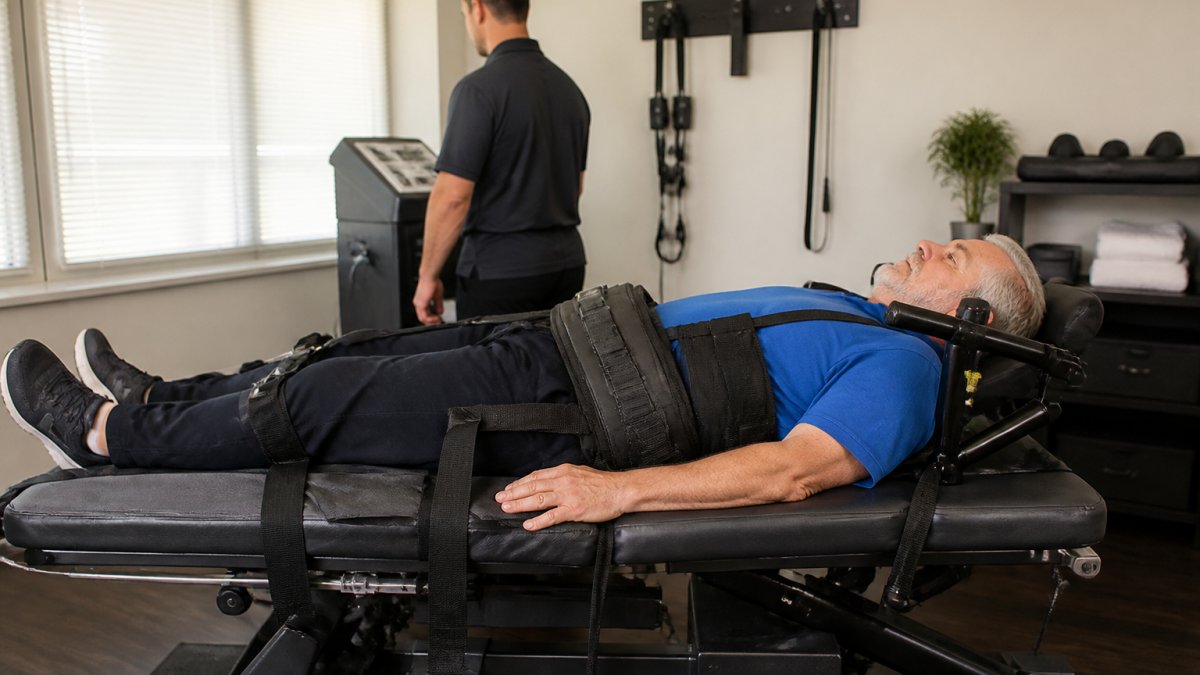
The therapy gently stretches the spine on a specialized table, creating a pressure gradient that draws herniated or bulging disc material back toward the center and reduces nerve compression, while promoting nutrient-rich fluid circulation to damaged discs.
The Mechanism Behind Decompression
During a session, you lie on a motorized table that applies precise, graduated traction to specific spinal segments, lumbar, cervical, or thoracic, based on your condition.
Negative pressure inside the disc space encourages bulging or herniated material to retract, while reduced pressure lets oxygen and nutrients flow back into the disc.
Conditions It Targets
Spinal decompression therapy addresses several common spinal conditions. Herniated discs respond well because negative pressure helps reposition the displaced material, and bulging discs benefit from gentle stretching and pressure reduction.
Sciatica often improves when the underlying cause is disc-related nerve compression. Facet joint pain, degenerative disc disease, and spinal stenosis are additional conditions where decompression may provide relief.
Spinal Decompression Therapy Benefits: What the Research Shows
The potential benefits of spinal decompression therapy center on pain reduction and improved function. Patients often report decreased leg pain, reduced numbness and tingling, and improved mobility. But what does the evidence show?
Pain Relief and Symptom Improvement
Pain relief is the primary outcome patients seek, and research suggests decompression therapy can deliver meaningful improvement for appropriate candidates. According to a review published in PubMed Central, patients with ruptured discs receiving decompression reported good or excellent results in their pain and functional outcomes.
Symptom improvement typically includes reduced lower back pain, neck pain, and radiating nerve pain such as sciatica, and some patients see relief in leg weakness or numbness as nerve pressure decreases.
Reported Outcome Rates
Research from a 2025 case series in the Parker University journal documented good-to-excellent clinical outcomes for patients with lumbar disc lesions treated with nonsurgical decompression.
Reported success rates vary across studies. A comparison cited in the PubMed Central review showed 86% of ruptured-disc patients receiving decompression reported good or excellent results, versus 55% of traction subjects, a difference that underscores how decompression’s mechanism differs from standard traction.
Reported outcomes suggest spinal decompression therapy can provide meaningful pain relief for disc-related conditions, but individual results depend on your specific diagnosis and commitment to the treatment plan.
Spinal Decompression Therapy Risks and Limitations
Like any medical treatment, spinal decompression therapy carries potential risks and isn’t appropriate for everyone.
Known Side Effects and Adverse Events
Most patients tolerate decompression therapy well, with minimal side effects. However, according to the 2007 review in PubMed Central, adverse events can occur and should not be assumed risk-free, despite marketing claims suggesting otherwise.
Common mild side effects include temporary muscle soreness, minor discomfort during initial sessions, and occasional headaches. Rare but more serious complications include nerve irritation, temporary pain increase, or disc herniation progression.
Who Should Avoid This Treatment
Patients with spinal fusion hardware, severe osteoporosis, active infection, malignancy, pregnancy, severe spinal instability, or fracture should avoid decompression. Those whose pain stems from facet joint arthritis alone may not benefit, since decompression targets disc-related pressure specifically.
If you have a history of spinal surgery, severe bone loss, or unexplained weight loss with back pain, consult a qualified healthcare provider before pursuing decompression therapy. These factors may indicate conditions requiring different treatment approaches.
How Long Does Spinal Decompression Therapy Take to Work?
Treatment duration depends on your condition severity, overall health, and how your body responds to therapy.
Treatment Duration and Session Frequency
A typical program involves multiple sessions over several weeks. Sessions usually last 30-45 minutes, with the decompression portion often 20-30 minutes, and most plans call for 3-5 sessions per week initially, tapering to 2-3 as improvement occurs.
Total sessions vary widely, some patients complete 15-20, others 30-40 or more. Gil Center for Back, Neck, and Chronic Pain Relief is tailored to your diagnosis and response, with disc herniation size, nerve compression severity, and healing capacity all influencing the count.
Timeline for Symptom Relief
Most patients notice some improvement within the first 2-3 weeks of consistent treatment, though initial relief may be subtle. More substantial improvement typically emerges by week 4-6 as cumulative decompression effects allow discs to heal and inflammation to decrease.
Patience is essential: spinal discs heal slowly because they have limited blood supply, so consistency matters more than intensity, completing prescribed sessions regularly produces better results than sporadic ones.
Spinal Decompression Therapy vs. Traction: Key Differences
Patients often confuse spinal decompression therapy with traditional traction, and both are sometimes confused with surgical decompression. They are different treatments with different mechanisms, evidence, and roles.
How They Compare
Traditional traction applies continuous or sustained stretching force using weights or pulleys. It can help some conditions, but the constant force often triggers the body’s protective muscle-tensioning response, limiting effectiveness.
Spinal decompression therapy uses intermittent cycles of stretching and relaxation to reduce muscular guarding and allow deeper decompression, this is how spinal decompression therapy work differs from traditional traction.
| Factor | Decompression Therapy | Traditional Traction |
|---|---|---|
| Force application | Intermittent cycles | Continuous or sustained |
| Muscle response | Minimal guarding | Often triggers tension |
| Precision targeting | Segment-specific | Broader spinal region |
| Negative pressure creation | Optimized for disc retraction | Limited disc pressure reduction |
| Typical session length | 20-30 minutes active | 15-30 minutes |
Decompression, Traction, and Surgical Decompression Are Not the Same
The shared word “decompression” causes confusion:
- Machine-based nonsurgical decompression is the table-based therapy described above. It is noninvasive and delivered in an outpatient setting.
- Traditional traction is a related but distinct form of sustained or intermittent pulling, often with simpler equipment and less segment-specific targeting.
- Surgical decompression is an operation, such as a discectomy, laminectomy, or fusion, that physically removes or relieves pressure on a nerve. It is invasive, carries surgical risks, and is generally reserved for cases with progressive neurologic deficits, cauda equina syndrome, or pain that has not responded to conservative care.
When a study or clinic cites a “decompression success rate,” check which of the three it means, mixing them up is a common source of misleading claims.
How Decompression Compares With Other Nonsurgical Options
Decompression is one option among several; the right choice depends on diagnosis, severity, and response to initial care:
- Exercise-based physical therapy builds strength, mobility, and motor control. It is widely recommended as first-line care for most lumbar and cervical disc-related pain and has a broad evidence base.
- Medications such as nonsteroidal anti-inflammatory drugs, muscle relaxants, and neuropathic pain agents can reduce symptoms but do not change the underlying mechanics.
- Epidural steroid injections deliver anti-inflammatory medication near the affected nerve and can provide temporary relief that supports participation in therapy.
A common pattern starts with activity modification and physical therapy, adds decompression or injections when symptoms persist, and reserves surgery for refractory or urgent cases. Decompression is often used alongside exercise rather than instead of it.
When Each Approach May Be Appropriate
Traditional traction may help certain muscle-tension conditions or serve as preliminary stretching. For true disc herniation or nerve compression, decompression’s intermittent mechanism may offer advantages, though head-to-head evidence against other conservative care is limited. Surgery is generally reserved for progressive weakness, saddle numbness, loss of bladder or bowel control, or disabling pain despite a reasonable trial of nonsurgical treatment.
Seek urgent medical care for progressive weakness, saddle numbness, or loss of bladder or bowel control. These are red flags for a serious condition such as cauda equina syndrome and are not appropriate for outpatient decompression therapy.
Decompression, traction, and surgical decompression are three different treatments. Ask which one a study or clinic is describing, and treat decompression as one part of a care plan that may also include physical therapy, medication, injections, or surgery.
What the Evidence Actually Says About Effectiveness
The evidence for spinal decompression therapy is encouraging but limited, and study quality matters as much as headline numbers. Here is what studies show versus what they can prove.
Study Designs You Will Encounter
Most published research falls into a few categories, each carrying different weight:
- Case series and retrospective chart reviews follow patients who received treatment and report how many improved. They are common because they are inexpensive, but they lack a control group, so they cannot rule out natural recovery, regression to the mean (flare-ups often improve on their own), or the placebo effect.
- Prospective cohort studies track patients forward in time with predefined outcomes. They are stronger than case series but still do not randomly assign treatment, so selection bias remains possible.
- Randomized controlled trials (RCTs) assign patients by chance to decompression versus another treatment or a sham. RCTs are the design that can best support a cause-and-effect claim, and they are relatively scarce for decompression.
When you read a success rate, first ask which design produced it. The 2025 Parker University case series, for example, documented good-to-excellent outcomes for lumbar disc lesions, but a case series cannot by itself show the machine caused the improvement.
Why Reported Success Rates Need Context
A commonly cited comparison reports good or excellent results in roughly 86% of ruptured-disc patients receiving decompression versus about 55% receiving traction. Several factors temper how much weight that difference can bear:
- Sample size and setting. Many decompression studies enroll a few dozen to a few hundred patients at a single clinic, which limits how broadly the results generalize.
- Outcome definitions. “Good or excellent” is often a patient-reported global rating rather than a validated, blinded measure. Different studies define success differently, so rates are not directly comparable.
- Co-interventions. Patients frequently receive decompression alongside exercise, medication, or manual therapy, making it hard to isolate the machine’s contribution.
None of this means decompression does not work. The honest conclusion is that evidence supports it as a reasonable option for selected disc-related pain, while the precise size of benefit over placebo or other conservative care remains uncertain.
Objective Measures of Benefit
Rather than relying only on broad patient-reported percentages, look for outcomes that reflect meaningful change:
- Pain intensity on a validated 0-10 scale, and whether the reduction crosses the threshold patients typically consider worthwhile.
- Function and disability using instruments such as the Oswestry Disability Index or the Roland-Morris Disability Questionnaire.
- Quality of life and return-to-work or return-to-activity rates.
A treatment that improves pain scores but not function, or vice versa, tells a different story than one that improves both.
Gaps in the Research and What Remains Unclear
Several questions remain open. Long-term durability needs more study, predictive factors for who responds best are not well defined, optimal session counts vary across protocols, and head-to-head research comparing decompression with exercise-based physical therapy, injections, and medications is limited.
When evaluating spinal decompression therapy, look for providers who discuss both the evidence supporting the treatment and its limitations. Honest assessment of what research shows, and what remains unclear, indicates a practitioner focused on appropriate patient selection rather than universal promotion.
Is Spinal Decompression Right for You?
Determining candidacy requires honest assessment of your condition, health status, and treatment goals, not everyone benefits, and recognizing this prevents wasted time and resources.
Candidate Selection and Personalized Assessment
Strong candidates typically have disc-related pain (herniated, bulging, or degenerative discs) causing localized or radiating symptoms.
Conversely, if your pain stems primarily from facet joint arthritis, muscle tension without disc involvement, or other non-mechanical causes, decompression may provide limited benefit.
Your commitment matters: treatment requires consistent attendance over weeks, and unreliable participation hurts results.
Spinal decompression therapy is a legitimate nonsurgical option for disc-related pain when appropriate candidates are selected and realistic expectations are set. The evidence supports its use for herniated discs and nerve compression, though individual results vary.
Frequently Asked Questions
What is the success rate of spinal decompression therapy?
Research shows mixed results. One study reported good or excellent outcomes in 86% of patients with herniated discs treated with decompression, compared to 55% receiving traction. However, a 2025 case series also reported good-to-excellent clinical outcomes for lumbar disc lesions. The evidence is not conclusive, and outcomes vary based on individual factors like condition severity, treatment compliance, and overall health. Consult a healthcare provider to understand what success might look like for your specific situation.
How long does spinal decompression therapy take to work?
Most treatment programs involve multiple sessions over several weeks. The timeline for symptom relief varies widely depending on your condition, the severity of nerve compression, and how your body responds to therapy. Some patients report improvement within a few weeks, while others require longer programs to experience meaningful pain reduction. Your treatment plan will be customized to your needs, and your provider can give you a realistic timeframe based on your assessment.
What are the main risks of spinal decompression therapy?
While marketed as safe, spinal decompression therapy can have adverse events. Potential side effects include temporary discomfort, muscle soreness, or aggravation of symptoms in some cases. The therapy is not appropriate for everyone, certain conditions, unstable spine segments, or specific health factors may contraindicate treatment. A thorough evaluation by a qualified professional is essential to determine whether this therapy is safe and suitable for your condition.
How does spinal decompression therapy differ from traction?
Both use spinal stretching to reduce pressure on discs and nerves, but they differ in method and control. Spinal decompression therapy typically uses motorized tables or equipment that apply precise, controlled negative pressure in specific directions. Traditional traction is often manual or uses simpler mechanical systems. Decompression therapy allows for more targeted treatment parameters and may be adjusted based on patient response. Your provider can recommend which approach fits your condition and treatment goals.


