

Table of Contents
- Understanding Advanced Back Pain Relief Technologies
- Non-Surgical Alternatives for Chronic Back Pain
- Spinal Decompression Therapy Benefits for Disc Issues
- Laser Therapy for Back Pain: How It Works
- Emerging Technologies: Spinal Cord Stimulation and Nerve Ablation
- At-Home Technologies for Back Pain Relief
- Choosing the Right Technology for Your Pain
- Frequently Asked Questions
Last Updated: October 4, 2026
Understanding Advanced Back Pain Relief Technologies
Advanced back pain relief technologies are medical devices and minimally invasive procedures that interrupt pain signals or repair spinal structures without open surgery. This guide from Dr. Gil Center for Back, Neck, and Chronic Pain Relief covers how each option works and who tends to benefit.
Chronic back pain affects millions of adults, and the treatment landscape has shifted dramatically. Where surgery was once the only option after conservative care failed, patients now have a growing menu of technologies that target pain at its source. The five approaches we cover here range from wearable devices you can use at home to implantable systems that modulate nerve signals.
Below, we’ll show you exactly how each technology works, who it suits, and what the trade-offs look like.
How Modern Technologies Target Pain Pathways
Every technology in this guide works by interfering with one of three things: pain signal transmission, disc pressure, or tissue inflammation. Some do all three.
Neuromodulation is the umbrella term for devices that alter nerve activity. Electrical impulses, delivered through implanted leads or external pads, can block pain signals before they reach the brain. The National Institute of Neurological Disorders and Stroke overview of pain explains how these pathways carry signals from the spine upward.
The other category is structural. Spinal decompression, laser therapy, and nerve ablation physically change the environment around the disc or nerve root. That distinction matters when you’re choosing a treatment.
Non-Surgical Alternatives for Chronic Back Pain
Non-surgical alternatives for chronic back pain include spinal decompression, laser therapy, nerve ablation, and spinal cord stimulation. Most patients start here before considering surgery.
Spinal decompression therapy is one of the most established options. A motorized table applies controlled traction to the spine, creating negative pressure inside the disc. That pressure can draw a herniated or bulging disc material back toward its center, away from the nerve root. Sessions typically run 30 to 45 minutes, and a full course often spans several weeks.
A common mistake is treating these technologies as competing options. In practice, the strongest results often come from combining them, such as pairing decompression with laser therapy to address both disc pressure and inflammation.
Patients often ask whether these approaches actually work for long-standing pain. Many find that a structured, multi-week program produces gradual improvement rather than instant relief, which is why consistency matters more than any single session.
Spinal Decompression Therapy Benefits for Disc Issues
Spinal decompression therapy benefits patients with herniated discs, degenerative disc disease, and sciatica by reducing pressure on compressed nerves. The goal is to restore disc height and improve nutrient flow to the disc.
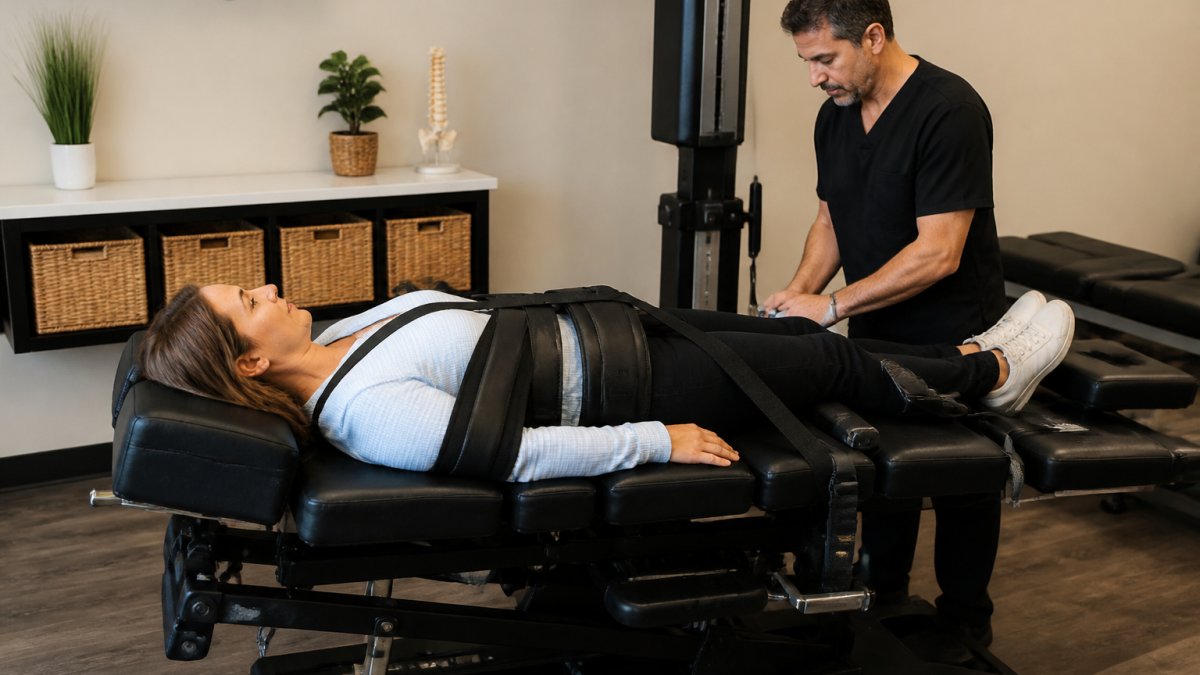
The nucleus pulposus, the gel-like center of a disc, loses hydration with age. That loss reduces its shock absorption, and the disc can bulge outward. Decompression aims to reverse some of that pressure and let the disc rehydrate.
Where it falls short: decompression is not a fix for every diagnosis. Patients with severe spinal instability or certain fractures may not be candidates. A proper evaluation should come first.
Laser Therapy for Back Pain: How It Works
Laser therapy for back pain uses focused light energy to reduce inflammation and stimulate tissue repair at the cellular level. Class 3 and Class 4 lasers penetrate deeper than earlier devices, reaching muscles and joint tissue.
The treatment is non-invasive. A clinician moves the laser over the affected area, and most patients feel only mild warmth. Sessions are short, often 10 to 20 minutes.
What most guides miss is the difference between laser classes. Class 3 lasers deliver lower power for surface-level issues. Class 4 lasers reach deeper tissue, which makes them more useful for chronic muscular and joint pain. The FDA guidance on medical laser devices outlines how these devices are regulated and classified.
Emerging Technologies: Spinal Cord Stimulation and Nerve Ablation
Spinal cord stimulation and nerve ablation represent the more advanced end of the spectrum. Both are minimally invasive procedures, and both target specific nerve pathways rather than broad tissue areas. They also carry the highest bar for candidacy, which is why a structured evaluation matters more here than with any other option in this guide.
Spinal Cord Stimulation (SCS) Systems
An SCS system delivers electrical impulses to the epidural space, the area just outside the spinal cord. The FDA overview of spinal cord stimulators explains how these devices are cleared and what they are indicated for.
The device requires a surgical implant, and a trial period usually comes first.
Mechanism of action. The leads sit in the epidural space and deliver pulses that activate large-diameter nerve fibers. Those fibers, in turn, modulate the transmission of pain signals in the dorsal horn of the spinal cord.
Side-effect profile. The most common issues are lead migration, infection at the implant site, and discomfort from the pulse itself. Battery replacement is a long-term consideration, and MRI compatibility varies by device.
Long-term efficacy. SCS is not a cure. Many patients report meaningful pain reduction and improved function, but the degree varies. Some patients need programming adjustments over time, and a minority choose to have the device removed.
Basivertebral Nerve Ablation (BVNA)
Basivertebral nerve ablation targets a specific nerve inside the vertebral body. For patients whose pain originates from the vertebral endplates, a condition called vertebrogenic pain, this procedure uses radiofrequency energy to disrupt that nerve.
Mechanism of action. The basivertebral nerve runs through the vertebral body and carries pain signals from the endplates. By heating the nerve with radiofrequency energy, the procedure interrupts those signals.
Candidacy. BVNA is not appropriate for every type of back pain.
Side-effect profile. Because the procedure is minimally invasive and does not require spinal fusion or hardware, recovery is typically short. Reported risks include transient numbness, soreness at the entry site, and, rarely, nerve injury.
Long-term efficacy. Studies of BVNA have shown sustained pain reduction in many patients at one and two years, though results vary. It is not a guarantee, and some patients see only partial relief.
| Technology | How It Works | Invasiveness | Best For |
|---|---|---|---|
| Spinal decompression | Relieves disc pressure via traction | Non-invasive | Herniated discs, sciatica |
| Laser therapy | Reduces inflammation with light energy | Non-invasive | Muscular and joint pain |
| Spinal cord stimulation | Electrical impulses block pain signals | Implant required | Intractable chronic pain |
| Nerve ablation | Radiofrequency disrupts a specific nerve | Minimally invasive | Vertebrogenic pain |
Both SCS and BVNA are targeted procedures, not general back pain fixes. The strongest outcomes come from matching the technology to a specific, confirmed diagnosis, not from choosing the most advanced-sounding option.
At-Home Technologies for Back Pain Relief
At-home devices handle muscle tension and surface-level discomfort, not structural disc problems. They work best as a complement to clinical treatment, not a replacement. That distinction is the one most product roundups skip, and it is the one that matters most when you are deciding where to spend your time and money.
What These Devices Actually Do
The Therabody ThermBack LED combines far-infrared heat with red and near-infrared LED modules for lower back relief. The Hyperice Venom 2 Back pairs heat with three vibration patterns for muscle recovery. Percussive tools like the Theragun Prime work on general soreness in the lumbar and thoracic regions.
Each of these targets the muscular layer. Heat increases blood flow and relaxes tight tissue. Vibration and percussion stimulate mechanoreceptors, which can temporarily reduce the perception of pain through the same gate-control principle that larger devices use. None of them decompress a disc, modulate a spinal nerve, or repair endplate damage.
Who Benefits, and Who Does Not
At-home devices tend to help patients whose pain is primarily muscular: post-exercise soreness, tension from prolonged sitting, or general stiffness. They are less useful for patients with radiating pain, numbness, or weakness, which usually point to a nerve or disc issue that requires clinical evaluation.
A practical rule: if your pain stays in one area and eases with movement or heat, an at-home device may be a reasonable adjunct. If it travels down a leg, wakes you at night, or comes with tingling or weakness, it is a signal to get evaluated rather than to buy another gadget.
Integrating Devices With Clinical Care
Most practitioners find that at-home tools work best as a bridge between clinical sessions, not as a standalone plan. Used alongside spinal decompression or laser therapy, they can help maintain mobility and reduce muscle guarding between visits. Used alone for a structural problem, they may ease symptoms without addressing the cause, which can delay more effective treatment.
Lifestyle factors matter here too. Sleep position, sitting posture, core strength, and daily walking all influence how much these devices help. A device cannot outwork a day spent in a chair that does not support the lower back.
At-home devices are not a substitute for a diagnosis. If pain is persistent, worsening, or accompanied by neurological symptoms, seek an evaluation before relying on self-treatment.
A Note on Cost and Value
At-home devices vary widely in price and capability. Before buying, consider whether the device addresses your actual pain pattern. A percussive tool will not help a disc issue, and a heat wrap will not help a nerve compression. Matching the tool to the problem is the difference between a useful adjunct and an expensive distraction.
Choosing the Right Technology for Your Pain
The right technology depends on your diagnosis, not your symptoms alone. Two patients with identical pain can need completely different treatments.
Here is how we would think through it:
- Disc-related pain (herniation, degeneration): spinal decompression as a first-line option
- Inflammation and soft tissue pain: laser therapy, often alongside other care
- Vertebrogenic pain from the endplates: evaluation for nerve ablation
- Chronic, intractable pain after other options: spinal cord stimulation
- Daily muscle tension: at-home heat, vibration, or percussive devices
At Dr. Gil Center for Back, Neck, and Chronic Pain Relief, we build treatment plans around each patient’s diagnosis, history, and goals. Our approach pairs spinal decompression with Class 3 and 4 laser therapy, therapeutic ultrasound, and dry needling, and we focus on education so patients can maintain their recovery through lifestyle changes.
One caveat worth stating plainly: no technology here is a guaranteed cure. Outcomes vary, and a consultation with a qualified professional should come before any decision.
Chronic back pain rarely resolves on its own, and guessing at the right treatment can cost you months of unnecessary discomfort. At Dr. Gil Center for Back, Neck, and Chronic Pain Relief, we start with a thorough evaluation and build a plan around your specific diagnosis, combining spinal decompression, Class 3 and 4 laser therapy, and therapeutic ultrasound as your case requires.
Frequently Asked Questions
What is the newest technology available for treating lower back pain?
Recent advances include spinal cord stimulation systems that deliver electrical impulses to mask pain signals, basivertebral nerve ablation that targets specific nerves in the vertebral body, and injectable hydrogels being studied for disc regeneration. Non-surgical options like spinal decompression and Class IV laser therapy also continue to evolve. The right choice depends on your diagnosis and whether conservative treatments have provided relief.
What are the latest non-surgical technologies for chronic back pain?
Non-surgical alternatives for chronic back pain include spinal decompression therapy, which creates negative pressure to help discs retract; laser therapy for back pain, which uses light energy to reduce inflammation; therapeutic ultrasound; and wearable devices that combine heat and LED light. These approaches aim to address pain without surgery or opioids, though candidacy varies by condition.
How does spinal decompression therapy work for disc-related issues?
Spinal decompression therapy uses a motorized table to gently stretch the spine, creating negative pressure within the disc. This can help a herniated or bulging disc retract and allow nutrients to flow back into the disc space. Sessions typically last 30 to 45 minutes, and a course of treatment may involve multiple visits. It is a non-surgical option for disc-related pain.
What role does laser therapy play in modern pain management?
Laser therapy for back pain delivers specific wavelengths of light into tissue to reduce inflammation and promote healing. Class IV lasers penetrate deeper than earlier models. It is often used alongside other therapies like spinal decompression. Treatments are non-invasive and typically painless, though results vary by individual and condition.
Can advanced ultrasound therapy assist with chronic back discomfort?
Therapeutic ultrasound uses sound waves to generate deep heat in muscles and connective tissue, which can reduce stiffness and improve circulation. It is often combined with other modalities like dry needling or spinal decompression. While not a standalone cure, it can be part of a broader treatment plan for chronic back discomfort.


